

Stop Scaling the Wrong Message
AI can now deliver hundreds of creative variations at once, but if those variations start from a flawed cultural assumption, you’re just distributing irrelevance at scale. Here’s what the world’s sharpest marketing minds said about getting the human insight right first.
Something important was said in the south of France this summer at Cannes Lions Festival of Creativity, and it deserves a wider audience. A Claritas hosted panel of executives from Comcast Advertising, goop, Indeed, WPP, GroundTruth, and Goodway Group gathered to discuss what was dubbed When the Algorithm Meets Creative. What emerged was less of a technical briefing and more of a cultural warning: the brands winning with AI are the ones who refuse to let it skip the hard part.
For multicultural marketers, this is the conversation you have been waiting for someone to have out loud.
“So many companies seem to start with pick up the hammer and go looking for the nails. It’s really starting with the human insight first that is going to help you get the most out of AI.”
-Cliona Hayes, Head of Brand & Advertising at Indeed
The Germany Problem is Your Problem, Too
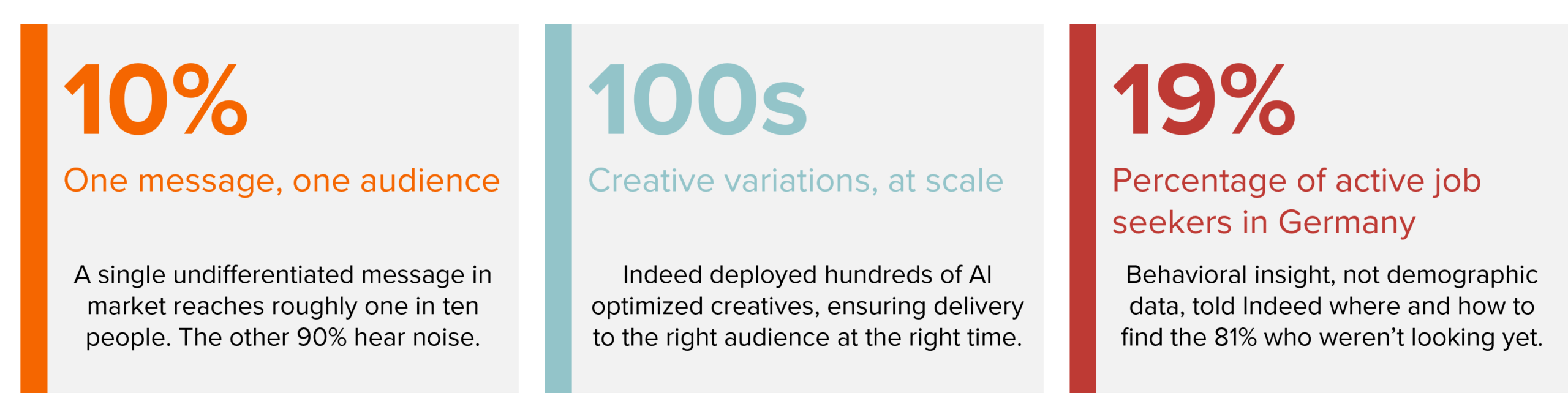
Indeed’s Sr. Director of Global Brand Marketing, Cliona Hayes offered one of the clearest case studies of the morning. Her team needed to reach 375,000 German knowledge workers for unfilled jobs. The challenge: Germans change jobs roughly every ten years, compared to every two to three years in the US or UK. 19% of that labor market is actively seeking work at any given time. Cultural inertia is the product.
Before anyone touched an AI tool, Indeed’s team went deep. They asked what would actually move someone who prizes job security above almost everything else. Within healthcare, exhaustion. Within manufacturing, the feeling of being treated like a machine. The impetus to move was different by sector, by life stage, and by identity. Only after that research were they able to guide AI to build hundreds of creative variants and let algorithms optimize toward people showing a propensity for action.
The campaign worked. But the lesson is portable: the AI did not generate the cultural insight. Humans did. The AI scaled it.
What This Means for Multicultural B2C Brands
The German labor market is not so different from any cultural segment you are trying to reach. Every community has its own pace, its own skepticism, its own version of “what would make me move?” Afro-Latino households navigating two cultural identities at once. South Asian American consumers making purchase decisions inside multigenerational family structures. Black consumers who have learned to read through the surface of a campaign to decide whether a brand actually sees them.
AI cannot generate that nuance from scratch. It can surface patterns in your existing data, but patterns in biased data produce biased outputs. What it can do is take the nuanced brief your team builds from real community knowledge and distribute it with precision and speed that no human team could match alone.
“AI is as good as the information we put in. If you are not putting in the right data, it’s just going to model what it thinks is simplest.”
-Dawn Williamson, CRO at Comcast Advertising
Signals Have Evolved, And So Have The Stakes
Four years ago at Cannes, the word was “trigger.” Three years ago, it was “signal.” The panelists agreed: even “signal” is close to becoming outdated. What the best platforms now offer is real-time observance of dynamic, moment-to-moment human behavior.
Danielle Kramer of GroundTruth described it this way: a person’s daily intent is not static. Whether she stops for her preferred coffee or grabs whatever is convenient depends on whether she left the house at 7:30 or 8:00 that morning, and what happened before she walked out the door. A static demographic segment will never capture that. An AI model reading real-world location behavior, in the moment, can.
For multicultural marketers, this has a specific implication. Cultural identity is also not static. A first-generation immigrant navigating multiple cultural contexts throughout the day is not the same consumer at 9 a.m. watching news in their parents’ language as they are at 1 p.m. buying lunch with colleagues. Relevance requires reading the moment, not just the profile.
The practitioner’s question: Are you reaching your audience based on their actual real-world behaviors, observed in the moment, or are you relying on inherited population models that treat your segment as a modifier?
The Silo is the Strategy Problem
Paul Frampton-Callero of Goodway Group put the structural challenge plainly: the industry has spent fifteen years creating fragmented specialist channels, and larger brands have organized their teams to match. Someone owns search. Another person owns paid social. Someone else owns programmatic. Someone else owns brand creative. None of them share a dashboard, and often none of them share accountability for profit and loss.
AI is cracking those walls open whether organizations are ready or not. The panelists described a world where brand and performance teams are being pulled together by the gravitational force of shared real-time data. Alexa Raff of goop described a tool that now lets her brand team set creative rules, hand them to the performance team, and update the entire system daily rather than weekly. Brand and performance are not just collaborating more; they are operating from a single source of truth.
For multicultural B2C teams, this convergence is overdue. How many times has a carefully constructed culturally resonant brand campaign been undermined by performance media buying that defaulted to the broadest possible audience? How many times has a community-specific insight gotten lost in translation between the brand strategist who developed it and the programmatic trader who executed it? The silos were never neutral. They had costs, and multicultural audiences paid them disproportionately.
FRAMEWORK
The Human-First AI Stack for Multicultural B2C
- Ground the brief in community research
Qualitative insight from within the community (not demographic proxies) defines the cultural truth your creative must carry. - Build guard rails, not guesses
Use that insight to set explicit creative and messaging parameters before any AI-generated variation begins. The guard rail is the cultural contract. - Instrument for real-world indicators
Behavioral data points that reflect how your community actually moves through the world outperform modeled demographic segments. Invest in the data that sees people, not categories. - Scale with AI, optimize toward outcomes
Let algorithms do what they are built for: distributing culturally grounded creative at speed, to the right person, at the right behavioral moment. - Measure incrementality, not just activity
Did a consumer’s behavior actually change? That is the question. Impressions and CTR are inputs.
Next Year: Tools Will Get Audited
One of the sharpest predictions from the panel came from Alexa Raff of goop, who noted that the conversation is about to shift from “adopt AI” to “does this AI actually earn its place?” Boards and leadership teams pressed hard on adoption in 2024 and 2025. The reckoning is coming: did those tools move the business, or did they just add cost and complexity?
For multicultural marketing specifically, this is a moment of leverage. If your organization is auditing its AI stack, bring the cultural effectiveness question into the room. A tool that accelerates the production of generic creative is not a multicultural marketing tool. A platform that lets you ground hundreds of variants in a single authentic cultural insight and distribute them with behavioral precision is different, and it is worth fighting for in the budget conversation.
Will Double of WPP described a future where data strategists, creative strategists, and business strategists sit together at the brief. That future is not automatic. It requires people in your organization to do a few things. Demand it, structure for it, and refuse to let the next technology wave be implemented in the same siloed way as the last one.
“The teams we’re going to see moving forward, in terms of composition of skill and talent, are going to be quite different in the future.”
-Cliona Hayes, Sr. Director of Global Brand Marketing at Indeed
Machine Availability is the New Frontier
Paul Frampton-Callero from Goodway Group offered one concept that deserves to become standard vocabulary in every multicultural marketing team: machine availability. Just as brands have spent decades building mental availability (the likelihood that a consumer thinks of you in a purchasing moment), brands now need to build machine availability: the likelihood that an LLM, an AI-powered search result, or an agentic shopping tool surfaces your brand when a consumer asks for something relevant.
For multicultural brands, this is simultaneously a threat and an opening. If the training data that powers these systems overrepresents mainstream consumer behavior, your community’s purchasing patterns and preferences will be systematically underweighted. But if you invest now in making your brand’s content, your community’s language, and your cultural context findable and indexable, you have a chance to shape how AI represents your audience before those patterns calcify.
goop’s team is already doing this: auditing metadata, working with LLMs to understand what gets surfaced, shifting dollars from traditional media toward the emerging ad products that live inside AI interfaces. It is early. The playbook is not written. That is exactly why now is the time to be writing it.
The Bottom Line
The executives at Cannes were not talking about AI as a replacement for human cultural intelligence. They were talking about it as an amplifier. Amplifiers do not fix a bad signal, they make it louder. Your community has seen enough loud campaigns that missed the mark. The opportunity in this moment is to do the hard cultural work first. Build the systems that preserve it through the production chain, and then let AI do what it is actually good at: getting the right message to the right person at the right moment, at a scale no team could achieve alone.
Start with the human. Scale with the machine. That sequence is not a constraint. It is the competitive advantage.
Want to watch the full 50-minute session? Click HERE.
Need help finding your next customer?
Questions
Please contact the Claritas Sales Team at866-ROI-TEAM (866-764-8326)
Current Clients
Please contact the Solution Center at855-400-ASST (855-400-2778) for immediate assistance