

Why Acquisition Email Deserves Another Look
Acquisition email has a reputation problem. For years, marketers have looked at it through the lens of their customer relationship management programs, seen a different performance pattern and concluded that the channel is weaker.
But that conclusion starts with the wrong comparison.
CRM email and acquisition email may share an inbox, but they do not share the same job. One speaks to people who already know the brand. The other introduces the brand to people who may be a strong fit but have not yet raised their hands. Expecting both programs to behave the same is like grading a first conversation by the standards of a long-term relationship.
Once acquisition email is evaluated on its own terms – using the right audience, controls and business outcomes – it deserves another look.
Note: Evolving Acquisition Email
Claritas has seen this mismatch firsthand. Over the years, its acquisition email solution has already helped brands reach beyond their customer files and turn new audiences into measurable growth. That experience also made the next opportunity clear: acquisition email could become more precise, more responsive and easier to connect to business results. Claritas Email Advantage builds on that proven foundation with deeper audience intelligence, current engagement signals and AI-supported optimization. It is an evolution of a successful solution, designed to learn faster and make smarter campaign decisions without losing the disciplined data, delivery and measurement practices that made the channel work in the first place.
Same inbox. Different job.
CRM email starts with familiarity. The recipient may be a customer, loyalty member, subscriber or recent site visitor. They recognize the sender. They may already have a purchase history, an account or an active relationship with the brand. That familiarity naturally creates an advantage at the open.
Acquisition email starts earlier. Its role is to reach relevant prospects outside the brand’s known customer file, earn attention and create a path to action. The first conversion may be a site visit, a product exploration, a request for information or a purchase. In many cases, the email does not close the journey by itself. It initiates it.
That distinction matters because the response patterns are different. Across more than 300 Claritas campaigns, typical business-to-consumer CRM programs produced open rates of 10% to 15% and click-through rates of 2% to 5%. Typical acquisition programs produced open rates of 2% to 5%, but click-through rates of 15% to 30% among openers.
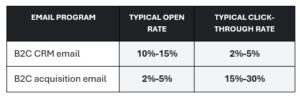
The lower acquisition open rate is not surprising: the sender is less familiar. The stronger click response among people who do open tells a more useful story. When the audience, message and moment align, acquisition email can generate meaningful intent. The channel should not be excused from performance expectations. It should be held to expectations that match its role.
The customer journey no longer stays in one channel
Ecommerce has made buying more convenient, but it has not made buying journeys more linear. A consumer may notice a product in an email, search for the brand later, compare options on a phone, read reviews on a laptop and purchase days later through a website, app or store.
That fragmentation increases the value of a channel that can reach an identifiable person directly. Email is addressable, measurable and able to carry a consumer from awareness into deeper consideration. It can also work in concert with display, social and other digital channels, reinforcing the message as the prospect moves across devices and platforms.
The implication is important: an acquisition email does not need to receive last-click credit to have influenced the outcome. It may be the first useful signal in a journey that converts somewhere else.
Opens and clicks are signals. Acquisition is the outcome.
Opens still provide directional information, but they have always been an incomplete measure of business value. Privacy protections, image-loading behavior and automated activity can make them even less definitive. A subject line may earn attention without generating action. A campaign may also influence action that happens well after the open.
Clicks are stronger expressions of interest, especially in an acquisition program. They show that a prospect chose to move closer. But clicks are still not the finish line.
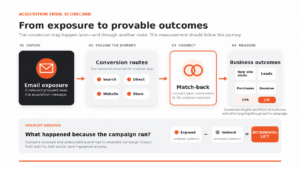
The most useful acquisition scorecard connects exposure to outcomes: new site visits, leads, purchases, revenue, cost per acquisition and incremental lift. Match-back analysis can identify conversions that occurred after an email exposure, even when the consumer returned through another route. Holdout groups can help answer the harder question: how much activity happened because the campaign ran?
This does not mean every marketer should ignore engagement metrics. It means those metrics should sit in the right place. Opens help diagnose attention. Clicks help diagnose intent. Acquisition outcomes determine whether the program created value.
The concerns are real. The answer is discipline.
Skepticism about acquisition email usually centers on three issues: privacy, list quality and deliverability. All three deserve scrutiny. None is solved by simply purchasing more names or sending more volume.
Privacy begins with responsible, permission-based data practices and compliance with applicable laws and standards. Marketers need clarity on how addresses were sourced, what permissions apply and how consumer choices are honored.
List quality requires ongoing hygiene. Valid domains and syntax matter, but quality goes further: suppressing invalid addresses and known spam traps, identifying a person’s active or preferred email and avoiding stale records that inflate volume without improving reach.
Deliverability depends on controlled execution. Sending infrastructure, reputation monitoring, deployment cadence, frequency and suppression practices all influence whether a message reaches the inbox. Audience relevance matters, too. Better selection reduces waste and gives the program a stronger foundation than broad, undifferentiated outreach.
In other words, the risks are not arguments against acquisition email. They are requirements for doing it well.
A proven channel gets more intelligent
The category is moving beyond static lists and one-size-fits-all sends. Claritas Email Advantage advances an already successful solution by bringing together audience intelligence, current engagement signals, and campaign execution with Claritas AI Audiences and AI-optimized lines.
Claritas AI Audiences uses campaign conversion data to identify receptive audience patterns and uncover segments that static targeting may miss. As results accumulate, targeting adjusts throughout the campaign. At the same time, subject-line optimization evaluates response by segment and applies the most relevant option for each audience.
AI is not there to replace strategy or simply add another label to the channel. It helps the program evaluate more signals, learn from live response and optimize decisions by audience segment as the campaign develops.
The goal is not to make acquisition email imitate CRM. It is to make the channel more precise, more adaptive and more accountable to the growth outcomes it was hired to deliver.
That starts with a more responsive process: define the audience, activate the campaign, use conversion data to refine targeting and subject lines, then connect exposure to outcomes through match-back reporting and holdout groups. When those pieces work together, acquisition email becomes more than a deployment. It becomes a learning system that improves as the campaign runs.
Acquisition email deserves another look because the customer journey has changed, the technology has changed and the measurement can finally reflect the channel’s real job. The question is no longer whether it can match a CRM open rate. The question is whether it can create net-new demand efficiently – and prove it.
READY TO RECONSIDER THE CHANNEL?
Explore Claritas Email Advantage ⇒
Coming next: From List to Lift
In the second article in this series, we will look inside the new acquisition email engine: how AI Audiences uses conversion data to uncover receptive segments and refine targeting throughout a campaign, how subject-line optimization adapts messaging by segment, and how match-back reporting and holdout groups connect campaign activity to measurable outcomes. Stay tuned.
Need help finding your next customer?
Questions
Please contact the Claritas Sales Team at866-ROI-TEAM (866-764-8326)
Current Clients
Please contact the Solution Center at855-400-ASST (855-400-2778) for immediate assistance