

The Connected Household
Part 1: Stop Marketing Products. Start Marketing Connected Households.
For decades, technology marketers have organized their businesses around products:
Broadband teams market internet speeds.
Smart-home companies market connected devices.
Utilities promote energy efficiency programs.
Telecom providers sell mobile plans and bundles.
From an organizational perspective, that makes perfect sense. From the consumer’s perspective, it doesn’t.
Today’s consumers think in experiences. They want reliable internet that keeps remote work uninterrupted. They want streaming that doesn’t buffer during movie night. They want a thermostat that saves money without sacrificing comfort, security cameras that provide peace of mind, and connected devices that simply work together.
In other words, they want a connected home.
That shift is exactly why Claritas developed the 2026 Tech Report: A Tech Marketer’s Guide to the New Connected Household. Rather than looking at broadband, smart-home technology, streaming, utilities, and emerging technologies as separate markets, the report explores how they converge into a single connected ecosystem and what that means for marketers.
The implications are bigger than they first appear.
Consumers Have Changed Faster Than Marketing Has
For years, companies competed by introducing the newest connected gadget or the fastest internet package. Today, consumers are asking different questions.
“Will this make my life easier?”
“Will it save me money?”
“Will everything work together?”
That’s an entirely different buying mindset.
Research cited in the report shows smart-home adoption has expanded well beyond early adopters, with millions of additional households embracing connected technologies over the past several years. The connected home is becoming a practical lifestyle choice rather than a niche interest.
For marketers, that’s an important distinction. You’re no longer selling technology. You’re helping households solve problems.
The New Customer Journey Doesn’t Belong to One Brand
Think about what happens when someone installs fiber internet. That decision doesn’t end with broadband.
One decision creates another.
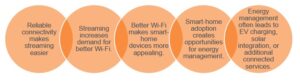
Consumers don’t experience these as separate purchases. They experience them as building a better home. Yet many companies continue marketing as though every purchase exists in isolation.
That disconnect creates missed opportunities.
The Real Opportunity Isn’t Selling More. It’s Seeing More.
Every connected device creates another signal.
- Heavy streaming may indicate demand for premium broadband.
- Smart thermostat ownership may suggest interest in energy optimization.
- Multiple connected devices often signal a household that’s ready for managed Wi-Fi or home support services.
Viewed individually, these are simply customer behaviors. Viewed together, they become a roadmap.
Instead of asking, “Who should we target?” marketers can begin asking a more valuable question: “What is this household likely to need next?”
That’s where audience intelligence changes the conversation. It moves marketers beyond demographics and toward understanding behavior, intent, and readiness.
But insight alone doesn’t drive growth.
Once marketers understand which households are most likely to adopt, upgrade, or expand their connected ecosystem, they need to activate those audiences across the channels consumers actually use, from email and digital advertising to CTV, social, and direct mail. Just as importantly, they need to measure which messages, offers, and channels are driving engagement and continuously optimize campaigns as customer behaviors evolve.
Why This Matters Right Now
Technology categories are converging faster than marketing organizations.
Broadband providers are entering smart-home services. Utilities are becoming technology companies. Telecom providers are competing on home experiences rather than network coverage alone.
Meanwhile, consumers expect relevant, consistent experiences regardless of where they encounter a brand. Whether they’re responding to an email, seeing a connected TV ad, browsing online, or receiving a direct mail offer, they expect every interaction to reflect their needs and stage in the connected household journey.
That raises the bar for marketers. Success is no longer about executing campaigns in individual channels. It’s about connecting audience intelligence with coordinated multichannel activation, measuring performance across touchpoints, and using those insights to continually improve future campaigns.
Connected Households Require Connected Marketing
Consumers experience technology as one connected ecosystem.
Marketing should work the same way.
Identifying high-value households is only the beginning. The real advantage comes from connecting audience intelligence with activation, measurement, and optimization into one continuous cycle.
The most successful technology brands won’t simply launch better campaigns. They’ll build smarter marketing systems that learn from every interaction, adapt to changing customer behavior, and use AI to improve targeting, creative, channel mix, and performance over time.
In a marketplace where connected experiences continue to evolve, marketing must evolve just as quickly.
Looking Ahead …
Understanding the Connected Household is only the first step.
In our next article, we’ll explore why the future of technology marketing isn’t about collecting more data. It’s about recognizing the signals that tell you what customers are likely to do next.
Need help finding your next customer?
Questions
Please contact the Claritas Sales Team at866-ROI-TEAM (866-764-8326)
Current Clients
Please contact the Solution Center at855-400-ASST (855-400-2778) for immediate assistance